- The Lovell telescope's closure is seen as shortsighted, harming both science and diplomacy.
- Margaret Thatcher's policies from the 1980s are cited as a precedent for current funding issues.
- UKRI’s budget has shifted focus away from research councils to industry-focused funding.
Impact on Science Facilities
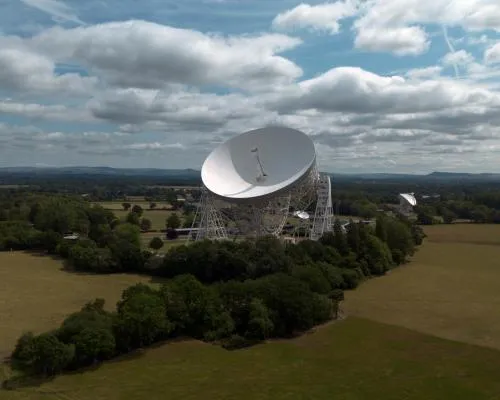
The decision to cease funding the Lovell telescope at Jodrell Bank Observatory from March 2028 is being widely condemned as shortsighted and potentially harmful. The observatory's role extends beyond astronomy, serving as a symbol of UK scientific leadership and fostering science diplomacy. Closure of this iconic facility would weaken its ability to contribute significantly to radio astronomy projects.
As a PhD researcher at Jodrell Bank in the 1960s, George Kildare Miley, Emeritus professor of astronomy from Leiden University, the Netherlands, recalls firsthand how innovations at Jodrell transformed radio astronomy. The Lovell telescope played a pioneering role in developing long-baseline radio interferometry, linking separate telescopes together to create virtual telescopes thousands of miles across. Removing the Lovell telescope from this network would weaken its ability to produce pictures of the radio universe with sharpness comparable to that achieved by billion-pound space observatories such as Hubble.
Historical Context

The current funding crisis in British research dates back to the 1980s. In the late 1980s, Mick Foster from Chelmsford, Essex, served briefly as an economic adviser to the chief scientist at the Cabinet Office. According to Foster, the policy was to rate research funding on objective criteria such as the number of peer-reviewed publications and citations, with a focus on near-term economic benefits.
However, he argued that there was no methodology for assessing which research would turn out to be economically beneficial, and the attempt to quantify success by counting publications had counterproductive effects. This approach aimed to ensure funding went to research expected to have immediate economic benefits but backfired in fostering a high-stress atmosphere and pressure to publish too much and too soon.
Current Budget Realities
The UK Research and Innovation (UKRI) budget is expected to rise to £10 billion by 2030. However, UKRI consists of research councils, which mostly fund fundamental science, plus Innovate UK, which funds only companies. The latter’s budget has risen significantly, while the former's has plummeted by up to 40-50% in real terms since 2011. As universities also capture a higher proportion of grants through overheads, the amount of actual science being funded is even lower.
This shift means that universities are now capturing a larger share of available grants through overheads, reducing the amount actually spent on scientific research. The flow of postdoctoral fellows needed to work in innovative industries is consequently being choked.
Consequences and Future Outlook
The reduction in funding for research councils is impacting postdoctoral fellows who play crucial roles in innovative industries. Critics warn that this could lead to a generation of UK scientists being sidelined from cutting-edge projects like the Large Hadron Collider beauty (LHCb) upgrade, which has been significantly impacted by funding cuts. They argue that restoring these funds would not only enhance technological development but also maintain UK leadership in international scientific collaborations.
Paula Collins, deputy spokesperson for LHCb at Cern, highlights that withdrawing previously secured funding risks cutting off a generation of UK scientists from the future of one of Cern’s four flagship experiments. The investment represents less than 0.05% of the UK's £10 billion annual research budget and should be swiftly restored to maintain international scientific collaborations and technological development.
The editorial from The Guardian criticizes this shortsighted attitude, emphasizing that modern astronomy now encompasses physics, chemistry, biology, and computing. Jodrell Bank Observatory has long been a symbol of UK scientific leadership and hope, and its closure would be detrimental. Ministers should reconsider their stance and recognize the importance of supporting fundamental science for long-term innovation and international collaborations.
Source: The Guardian

Science Daily
143 posts
-
 Expertos advierten sobre impacto catastrófico de los data centers espaciales
Las tecnológicas SpaceX y Blue Origin proponen millones de data centers en el espacio, pero expertos advierten sobre posibles consecuencias catastróficas que incluyen contaminación y daño al capa de ozono.
-
 Medicamentos GLP-1: Explorando los Efectos Secundarios Conocidos y Controvertidos
Los medicamentos GLP-1 han ganado popularidad en el manejo del peso, pero vienen con efectos secundarios conocidos y debatidos como problemas digestivos, condiciones oculares, riesgos de embarazo, cambios faciales, alopécia y dolor en los pies.
-
 Outbrava de cicolopsiria: ¿Se está frenando?
Un fabricante popular de pruebas informa una disminución en las tasas positivas de cicolopsiria, lo que eleva la esperanza de que el brote en los Estados Unidos pueda estar dejando de crecer.
-
 Ciudadanos urgen al gobierno a reconsiderar recortes de fondos que podrían llevar al cierre del Observatorio Jodrell Ban
 -
 Colisión antigua causó que la Vía Láctea se derrumbara hace 10 mil millones de años
 -
 GLP-1: Perdiendo Peso, Ganando Insights sobre Relaciones
El impacto de los medicamentos GLP-1 para el peso se extiende más allá de los cambios físicos, afectando relaciones personales y conexiones emocionales.
-
 Nueva investigación sugiere que Marte tuvo ríos extensos de magma bajo su superficie
Basado en datos del Lander Insight de NASA, una reciente estudio indica la presencia de sistemas magmáticos extensos bajo la corteza de Marte, lo cual podría ampliar el espectro de planetas que podrían haber soportado la vida temprana.
-
 Jodrell Bank enfrenta el cierre ante crisis de financiamiento científico en el Reino Unido
El sitio mundialmente conocido de astronomía por radio podría cerrar debido a recortes presupuestarios, lo que plantea preocupaciones sobre el futuro del avance científico en el Reino Unido.
-
 Comparte tus Experiencias: los Medicamentos GLP-1 no te Están Sirviendo?
El Guardian está recolectando historias personales de individuos que no han visto beneficios con los medicamentos GLP-1 como Wegovy y Mounjaro.
-
 Jodrell Bank enfrenta el cierre ante crisis de financiamiento
Recortes en la asignación de fondos ponen en riesgo Jodrell Bank y los esfuerzos científicos más amplios del Reino Unido, lo que podría dar lugar a una fuga de talento en física.
-
 Ex-NASA Astronautas Forman Grupo de Advocacia para Restaurar la Fe en la Democracia
Ex astronautas de NASA forman un grupo no partisano llamado Astronautas por Estados Unidos con el fin de fomentar el voto entre jóvenes y respaldar una democracia constitucional.


