- A four-tonne piece of discarded SpaceX Falcon 9 rocket stage crashed into the moon's surface.
- The impact, occurring at a high speed, poses no danger to Earth but could create a new lunar crater.
- Scientists from Nasa are planning to collect data from the event and improve techniques for tracking space debris.
What Happened
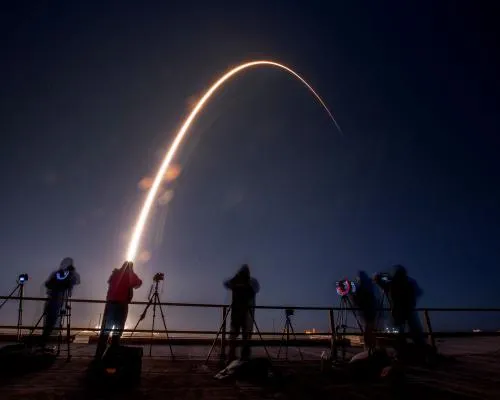
A four-tonne piece of a discarded SpaceX rocket that has been floating in space since last year is believed to have unintentionally crashed into the moon at high speed, in a collision that posed no danger to Earth but was expected to blast out a new lunar crater. The object, the height of a five-storey building, was part of the SpaceX Falcon 9 rocket that launched two commercial lunar landers, one from the US and one from Japan, towards the moon on January 25, 2025.The rocket body was due to hit the moon around 6:35 am BST, crashing into its surface at 8,690 km/h. This speed is equivalent to about 5,400 miles per hour (mph). The impact was predicted to kick up a plume of lunar dust that, although illuminated by sunlight, would be difficult to spot with the naked eye from Earth due to its location near the moon's edge.
Impact Details
Professional and amateur astronomers using high-quality telescopes and cameras were not able to confirm the impact on Wednesday. This may have been because the impact site was close to the visible edges of the moon, making it harder to detect even with advanced equipment. US and South Korean lunar satellites will be positioned to photograph the site after impact but it may take days to receive that information.Nasa said the impact was expected to create a crater about 18 meters wide and 4 meters deep and throw dust and rock outward as ejecta. The space agency stated, 'The impact poses no danger to Earth and Nasa scientists are planning to collect lunar data from the event and refine techniques for tracking objects in space.' Such rocket parts, known as stages, typically fall back into Earth’s atmosphere and burn up or plunge into the ocean after boosting the rocket's payload to a precise spot in orbit. However, because the January 2025 lunar lander mission required more thrust than missions closer to Earth, the rocket’s second stage remained in space, floating aimlessly among thousands of other pieces of space junk that active satellites must steer clear of.
Scientific Implications and Future Planning
It was not until this year that astronomers determined that the rocket stage, which had dumped its remaining fuel and could not be controlled, was on an orbital trajectory ending at the moon. Julianna Scheiman, SpaceX’s director of Nasa science and Dragon spacecraft programmes, told reporters on Monday: 'What has happened is essentially a mixture of solar activity and gravity forces have put it on a path toward the moon.' Bill Gray, the creator of a widely used piece of astronomy software who published a report on the stage's impact in April, said: 'This may be of some – probably minor – scientific interest, and we may learn some things from it. 'It doesn’t present any danger to anyone, though it does highlight a certain carelessness about how leftover space hardware [space junk] is disposed of.'While tens of thousands of pieces of space junk – defunct satellites, discarded rocket parts and debris from rocket launches – are increasingly crowding Earth’s orbit, human-made impacts on the moon are relatively rare. Multiple US and Soviet spacecraft intentionally or accidentally crashed into the moon during the 20th-century space race. More recently, a Chinese rocket stage crashed into the moon in March 2022 after completing a lunar test mission. In 2009, Nasa intentionally crashed a rocket stage into the moon to study the plume of lunar material kicked up by the impact.Several spacecraft intended to land softly on the moon in recent years have crashed instead, including Russia’s Luna-25 mission in 2023 and India’s Chandrayaan-2 lander mission in 2019. Israel’s Beresheet lander also crashed in 2019. Among the Israeli lander's payloads were tiny tardigrades, microscopic animals known for surviving radiation and other harsh environments, which may still be on the surface.
Scheiman said Nasa and SpaceX were discussing ways to prevent future lunar impacts. The SpaceX rocket carried two lunar landers for the 2025 mission, successfully launching them towards the moon. One, named Blue Ghost, was made by the US company Firefly Aerospace and achieved a soft landing on the moon’s north-eastern near side to conduct tests, including analyzing lunar soil. A second, 2-meter lander, made by the Japanese company ispace and containing a small robotic rover, crashed on final descent.
On Tuesday, SpaceX reported a smaller loss than Wall Street had expected, along with a surge in revenue, in its first quarterly report as a public company. Despite this, shares tumbled as investors remained skeptical about the company's ability to deliver on its lofty promises.
Source: The Guardian

Science Daily
148 posts
-
 Revolutionary Telescope Unveils Sun's Mysteries in Never-Before-Seen Detail
New observations from the Inouye solar telescope provide unprecedented detail of the sun's surface, including swirling vortices that could explain coronal heating and solar flares.
-
 Mathematical Puzzler: Exploring Grid Possibilities
A mathematical puzzle involving filling a 3×3 grid with numbers such that each row and column multiplies to 30, revealing the importance of prime factors in solving it.
-
 Study Reveals Link Between Early Social Media Use and Lower School Performance
A study finds that children who start using social media early tend to perform worse academically, suggesting a link between constant smartphone use and educational development.
-
 UK Science Funding Cuts Spark Concerns About Global Standing
Critics argue that recent funding cuts in UK science could harm global standing and stunt research advancements.
-
 British Science Funding Crisis Sparks Wide-Spread Concern
Letters from readers and experts critique the decision to cut science funding in Britain, emphasizing the potential long-term damage on research and innovation.
-
 Experts Warn of Catastrophic Impact of Space Datacenters
Tech giants propose millions of space data centers, but experts warn of potential catastrophic impacts including pollution and ozone layer damage.
-
 GLP-1 Medications: Exploring the Known and Controversial Side-Effects
GLP-1 medications have gained popularity in weight management but come with known and debated side-effects like digestive issues, eye conditions, pregnancy risks, facial changes, hair thinning, and foot pain.
-
 Cyclosporiasis Outbreak: Is It Slowing Down?
A popular test-maker reports a decline in cyclosporiasis positivity rates, raising hopes that the U.S. outbreak might be slowing.
-
 Alan Turing's Racy Short Story Reveals His Playful Side
A Cambridge academic has uncovered insights from an unpublished short story by Alan Turing, challenging the traditional view of him as an isolated mathematician and highlighting his playful, literary, and social sides.
-
 Public Urges Preservation of Jodrell Bank Observatory Amid Funding Cuts
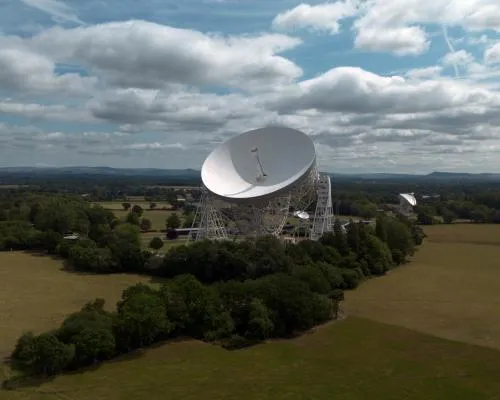
Citizens urge government to reconsider funding cuts that could lead to the closure of the historic Jodrell Bank Observatory.


