- A Cambridge academic has transcribed and studied a short story by Alan Turing, revealing his playful and humorous nature.
- The story challenges the traditional image of Turing as an isolated mathematician, highlighting his social life and literary interests.
- Turing's work on Bletchley Park and post-war computing is also discussed in context of this new insight into his personality.
- The story suggests Turing was not only a brilliant coder but also someone who enjoyed literature and had a vibrant personal life.
About Alan Turing
Alan Turing, the father of modern computing, is often remembered for his contributions to code-breaking during World War II and his pioneering work on artificial intelligence. However, he was much more than a solitary mathematician. A Cambridge academic has recently shed light on this side through the analysis of a previously underappreciated short story by Turing.
Discovering the Short Story
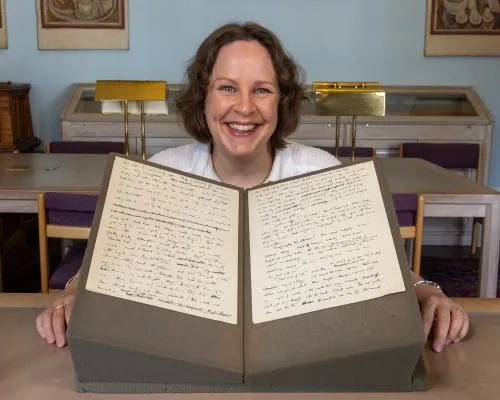
The short story, titled Pryce's Buoy, was discovered in the King’s College archives and has been known to experts but never fully transcribed or studied by a literary scholar. The Cambridge University English literature professor Sarah Dillon undertook this task, uncovering details that challenge the traditional portrayal of Turing.
Insights from the Story
The story offers a glimpse into Turing's playful and humorous side. Written after his arrest in Manchester for gross indecency, it features characters who are believed to be autobiographical representations of Turing himself. The narrative reveals Turing’s interest in literature, his social interactions, and his sexual experiences.
Implications for Understanding Turing
Dillon argues that the story challenges the perception of Turing as an isolated, humorless, and tortured figure. Instead, it portrays him as a man who loved literature, enjoyed life, and was not ashamed of his sexuality. This new understanding is significant because it aligns with other evidence suggesting that Turing’s personal life was more vibrant than previously acknowledged.
Historical Context
Turing's life was marked by both professional achievements and personal struggles. In 1952, he was arrested for gross indecency, leading to chemical castration. Despite these hardships, the story suggests that Turing maintained a positive outlook on his social interactions and sexuality. His arrest and subsequent treatment have been acknowledged as profoundly unjust; in 2009, the UK government apologized for its handling of the case.
Reception and Significance
The findings are published in The Review of English Studies, where Dillon hopes they will provide a fresh insight into this misunderstood genius. The story, she believes, offers a new perspective on Turing that is both playful and enlightening. It challenges the Hollywood portrayal of a one-dimensional, isolated figure, instead revealing a man who was multifaceted and vibrant.
Dillon emphasizes that the popular image of Turing as arrogant, isolated, humourless, or tortured is misleading. She argues, “I hope it will go some way towards resetting the narrative around Turing. We think we know this figure and we don’t. There was more to him than is popularly believed.”
Turing's work at Bletchley Park during World War II is well-documented. Some historians believe that his efforts, along with others, shortened the war by as many years as four. His post-war work at Manchester University laid the groundwork for modern computers and artificial intelligence. Despite these monumental achievements, Turing faced significant personal challenges.
After his arrest in 1952, Turing was given the choice of going to prison or undergoing chemical castration. He chose the latter, a punishment that many today consider cruel and unusual. This decision was made at a time when homosexuality was still criminalized in the UK. In 1954, Turing died at the age of 41 from cyanide poisoning, which was ruled as suicide by a coroner but is now seen by some as accidental.
The Hollywood portrayal of Turing, particularly in The Imitation Game, starring Benedict Cumberbatch, has been criticized for its inaccuracies. The film depicts Turing as having no sense of humor and being very individualistic with antagonistic relationships. Dillon argues that this depiction is
Source: The Guardian

Science Daily
142 posts
-
 Experts Warn of Catastrophic Impact of Space Datacenters
Tech giants propose millions of space data centers, but experts warn of potential catastrophic impacts including pollution and ozone layer damage.
-
 GLP-1 Medications: Exploring the Known and Controversial Side-Effects
GLP-1 medications have gained popularity in weight management but come with known and debated side-effects like digestive issues, eye conditions, pregnancy risks, facial changes, hair thinning, and foot pain.
-
 Cyclosporiasis Outbreak: Is It Slowing Down?
A popular test-maker reports a decline in cyclosporiasis positivity rates, raising hopes that the U.S. outbreak might be slowing.
-
 Public Urges Preservation of Jodrell Bank Observatory Amid Funding Cuts
Citizens urge government to reconsider funding cuts that could lead to the closure of the historic Jodrell Bank Observatory.
-
 Ancient Collision Caused Milky Way to Flip 10 Billion Years Ago
Astronomers have found evidence that a dwarf galaxy named Gaia Sausage struck the Milky Way 10 billion years ago, causing its disc to be flipped by more than 90 degrees. This significant event reshaped the Milky Way's structure and is crucial for understanding our galaxy’s history.
-
 The Precision of Fossil Dating: A Matter of Accuracy
Letters to The Guardian discuss fossil dating precision, an amusing museum tale, using soap for hair washing, George Harrison's 'Taxman,' and rating Marmite.
-
 Solving the Heatwave Puzzle: How Effective Are Double Layers of Curtains and Blinds?
A mathematical puzzle by Alex Bellos explores how double layers of curtains and blinds can reduce heat entering a room during a heatwave.
-
 GLP-1 Drugs: Losing Weight, Gaining Insights into Relationships
The impact of GLP-1 weight-loss drugs extends beyond physical changes, affecting personal relationships and emotional connections.
-
 Mars Had Extensive Magma Plumbing, Suggesting Potential for Life
Research suggests Mars once had extensive magma plumbing beneath its crust, potentially making it more habitable than previously thought.
-
 New Study Suggests Mars Had Extensive Magma Rivers Beneath Its Surface
New research based on data from NASA’s Insight Lander suggests Mars once had extensive magma rivers beneath its surface, potentially widening the scope of planets that may have supported early life.


