- Highest-resolution images from the Inouye solar telescope reveal previously unseen features on the sun’s surface.
- New findings include swirling vortices and signatures of Kelvin-Helmholtz instabilities, which could explain coronal heating.
- The observations offer insight into the mechanisms behind explosive events like solar flares and coronal mass ejections.
- Understanding these processes is crucial for predicting space weather impacts on Earth.
What happened
New Observations from the World’s Most Powerful Solar Telescope Reveal Sun's Turbulent Secrets
Scientists have made a groundbreaking discovery by capturing the sun's surface in unprecedented detail using the Inouye solar telescope in Hawaii. These highest-ever resolution images, revealing structures as small as 20 kilometers across, provide a closer look at processes that could explain one of the greatest mysteries in astronomy: why the sun’s outer atmosphere is millions of degrees hotter than its surface.
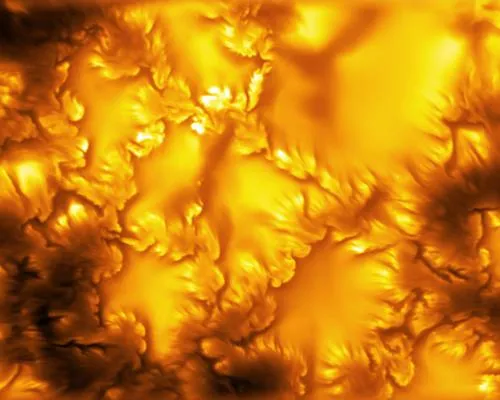
Dr. Friedrich Wöger from the US National Solar Observatory described these images as 'the highest spatial resolution pictures of the solar surface ever acquired.' In comparison to previous observations, which could identify structures only about 30 kilometers across, the latest images showcase finer-scale details never before seen in solar studies.
The new findings highlight structures that resemble small whirlpool-like patterns, identified as signatures of Kelvin-Helmholtz instabilities (KHIs). These occur when fast-moving plasma interacts with slower moving fluid, creating shear at their interface. In the sun's case, this process forms spiralling vortices similar to breaking waves. Although KHIs have been observed in various environments on Earth and other planets, their confirmation on the sun represents a significant scientific breakthrough.
These swirling vortices could be key to understanding how the sun’s magnetic fields become tangled, leading to explosive events like solar flares and coronal mass ejections. These phenomena can cause widespread disruption on Earth, including damaging power grids, satellites, and global communications systems. By studying these processes in detail, researchers hope to better predict and mitigate their effects.
Dr. David Kuridze, a member of the research team, stated, 'This is something we have never seen before in any solar observations.' The findings could solve a long-standing mystery in solar physics, explaining how energy is transferred from larger scales down to smaller ones through these instabilities and ultimately dissipated as heat.
‘When you have this instability in the system, it is very easy to cascade the energy into smaller scales. And at some point, it just dissipates as a heat. This could make hot coronas, hot outer atmospheres of the sun and similar stars,’ Kuridze added.
The new insights from these images are not only a significant step forward in solar research but also highlight the importance of continued investment in advanced observational technologies that can push the boundaries of what we know about our nearest star. As the team continues to analyze their data, further discoveries may bring us closer to fully understanding the sun’s complex dynamics and their implications for life on Earth.
Source: The Guardian

Science Daily
148 posts
-
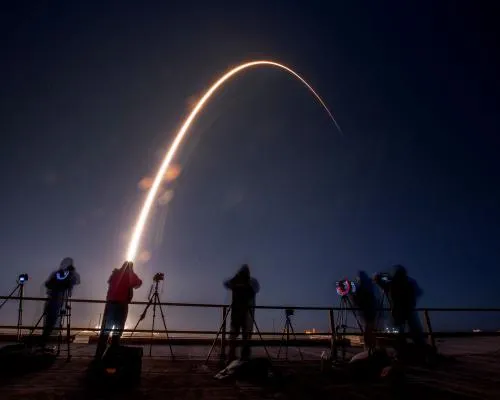 SpaceX Rocket Stage Crashes Into Moon: A Rare Incident of Lunar Impact
A four-tonne piece of a discarded SpaceX rocket crashed into the moon at high speed, creating a new lunar crater and posing no danger to Earth.
-
 Mathematical Puzzler: Exploring Grid Possibilities
A mathematical puzzle involving filling a 3×3 grid with numbers such that each row and column multiplies to 30, revealing the importance of prime factors in solving it.
-
 Study Reveals Link Between Early Social Media Use and Lower School Performance
A study finds that children who start using social media early tend to perform worse academically, suggesting a link between constant smartphone use and educational development.
-
 UK Science Funding Cuts Spark Concerns About Global Standing
Critics argue that recent funding cuts in UK science could harm global standing and stunt research advancements.
-
 British Science Funding Crisis Sparks Wide-Spread Concern
Letters from readers and experts critique the decision to cut science funding in Britain, emphasizing the potential long-term damage on research and innovation.
-
 Experts Warn of Catastrophic Impact of Space Datacenters
Tech giants propose millions of space data centers, but experts warn of potential catastrophic impacts including pollution and ozone layer damage.
-
 GLP-1 Medications: Exploring the Known and Controversial Side-Effects
GLP-1 medications have gained popularity in weight management but come with known and debated side-effects like digestive issues, eye conditions, pregnancy risks, facial changes, hair thinning, and foot pain.
-
 Cyclosporiasis Outbreak: Is It Slowing Down?
A popular test-maker reports a decline in cyclosporiasis positivity rates, raising hopes that the U.S. outbreak might be slowing.
-
 Alan Turing's Racy Short Story Reveals His Playful Side
A Cambridge academic has uncovered insights from an unpublished short story by Alan Turing, challenging the traditional view of him as an isolated mathematician and highlighting his playful, literary, and social sides.
-
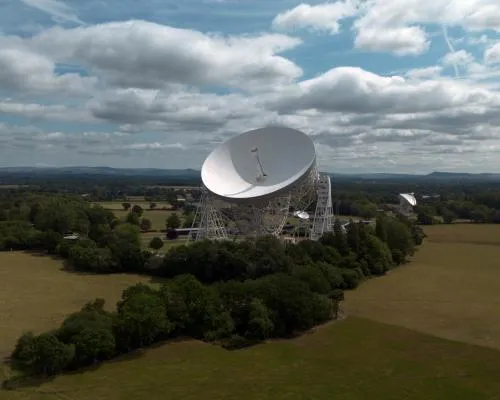 Public Urges Preservation of Jodrell Bank Observatory Amid Funding Cuts
Citizens urge government to reconsider funding cuts that could lead to the closure of the historic Jodrell Bank Observatory.


