- Takayna/Tarkine, one of Australia's largest cool temperate rainforests, shelters diverse fungi that are vital to forest ecosystems.
- Fungi, once considered plants, have their own kingdom and play a crucial role in environmental restoration through symbiotic relationships with over 70% of plant species.
- A three-day workshop led by Dr. Alison Pouliot highlights the importance of fungi beyond just mushrooms, including their hidden underground networks called mycelium.
Introduction to Tarkine’s Enigmatic Fungi
Takayna/Tarkine, revered as one of Australia's last true wilderness areas, is a place of legends. Here, freshwater crayfish that can reach almost a metre in length lurk in the shade of 2,000-year-old Huon pines, and every few years rumours emerge that thylacines still prowl the dense Gondwanan rainforest of north-west Tasmania. For 65 million years, this landscape has sheltered all manner of astonishing creatures.
However, some of the most fascinating life forms found here are even older. Before animals walked the Earth or trees began converting carbon dioxide into oxygen, fungi helped to create the conditions necessary for complex life on our planet. Dr Alison Pouliot, a mycologist, explains how these organisms have been overlooked despite their crucial role as 'ecosystem engineers.' These life forms are integral to creating the conditions necessary for complex life on Earth.
Understanding Fungi's Complex Role
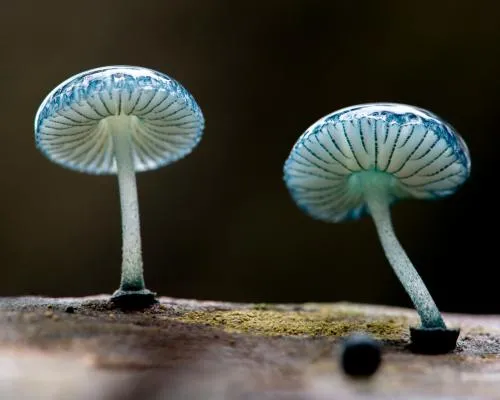
Fungi were recently classified into their own kingdom and remain understudied. Researchers estimate that there are 2-3 million species, of which only about 205,000 have been identified so far. The workshop participants include toxicologists, botanists, and ecologists who share a deep fascination with fungi.
Fungi's underground networks, known as mycelium, form vast interconnected systems that support many plant species. These fungal threads can be incredibly extensive; for instance, one specimen in Oregon covers more than 9 square kilometres and weighs an astonishing 30,000 tonnes.
Field Excursions and Discoveries
The three-day fungi workshop in Tarkayna involved excursions from a former mining town repurposed into an eco-friendly village. The participants followed the Pieman River and walked through ancient Huon pines and lush vegetation covered with mosses, lichens, and liverworts. The variety of fungi observed was astounding.
The group encountered delicate blue pixie's parasols, fields of ruby bonnets that look like bright red berries scattered across the forest floor, slime-covered earth tongues that resemble worms pushing up through the ground, giant bracket fungi the size of dinner plates, and echidna fungi with thousands of spiky teeth beneath their caps.
The wild variety of shapes and colours is matched by the incredible density of fungi. It often took less than 200 metres to cover an hour's walk as they searched for new species. Liz Davis, a long-time forager who has been foraging for 30 years and started the Mycology May festival in regional New South Wales, notes that it’s hard to believe there’s so much diversity in such a small space.
Reflecting on Fungi's Importance
The diversity and density of fungi in the rainforest are immense. Dr Pouliot quoted Sylvia Plath's poem 'Mushrooms,' which metaphorically linked fungi to gender equality and environmental resilience. The experience highlighted the undervalued role of fungi in ecosystems, despite their critical contributions.
By the end of the workshop, participants were deeply engaged with the fungal life, and the group felt a shared sense of urgency to raise awareness about the importance of these organisms. For instance, Pouliot emphasizes that much of the fungal life remains invisible below ground, making it hard to predict what species might be encountered on each visit.
The interdisciplinary approach of the workshop explored not only the vital role fungi play in ecosystems but also how language affects our perception of fungi—why does love bloom, but crime mushrooms? This exploration helped participants understand that their fungal knowledge is just the tip of the iceberg, with much more to be discovered and understood.
The experience at a former mining town repurposed into an eco-friendly village was both enlightening and awe-inspiring. The rainforest, built on a foundation of fungal life, offered a unique insight into the critical role these organisms play in maintaining ecological balance.
Source: The Guardian

Science Daily
113 posts
-
 New Insights Suggest Mars Once Had Extensive Subsurface Magma
New research reveals Mars once had extensive subsurface magma reservoirs, challenging previous assumptions and expanding the potential habitability of similar planets.
-
 Mars Had Extensive Magma Rivers Under Its Surface, Research Suggests
Mars once had extensive magma rivers beneath its surface, expanding our understanding of its potential habitability.
-
 Solving the Coin Flip Puzzle: A Strategy That Boosts Your Chances
A game show scenario improves participants' chances from 25% to 50% by sharing one simple strategy.
-
 Puzzle Solution Reveals Surprising Strategy
A game show presents a coin-flipping challenge with an unusual winning strategy that increases the chances of success from 25% to 50%. The puzzle highlights simple probability rules and strategic thinking.
-
 Mystery Mushroom in China Prompts Hallucinations of Tiny People
A rare bolete mushroom from China can induce hallucinations of tiny people lasting for days. Researchers are studying its unique properties.
-
 Gene Editing Debate Excludes Deaf Community
A letter from Tom Lichy of the British Deaf Association highlights the exclusion of deaf people from gene-editing debates, advocating for more inclusive policy making.
-
 David Armstrong: Shaping Organisational Psychology Through Systems Psychodynamics
David Armstrong, a psychologist who spent over six decades shaping systems psychodynamics, passed away at 91. His work emphasized workplace democracy as key to innovation and efficiency.
-
 David Armstrong: A Pioneering Psychologist Who Transformed Organisational Thinking
Pioneering psychologist David Armstrong spent six decades researching systems psychodynamics, developing a practical language for understanding unconscious dimensions of work.
-
 Innovative Brain Implant Restores Functionality in Paralyzed Man
A paralyzed man regains movement and touch sensation through a brain implant that bypasses his spinal cord injury, opening new possibilities for neurorehabilitation.
-
 UK Vet Industry Reforms May Include Prescription Caps, Licensing
The UK government is considering reforms to the veterinary sector, including prescription caps and mandatory licensing, aiming to address rising costs for pet owners.
-
 First Confirmed Atmosphere Around Rocky Exoplanet in Habitable Zone Discovered
Scientists have confirmed an atmosphere around LHS 1140b, a rocky exoplanet in the habitable zone outside our solar system.


