- Fogbows are optical illusions seen when sunlight illuminates fog, appearing like white rainbows.
- Conditions for seeing fogbows are very specific and require precise alignment of the sun, observer, and fog.
- Fogbows can be observed in southeastern Australia during autumn and winter due to radiation cooling.
What is a Fogbow?
A fogbow is a rare optical illusion that resembles a white rainbow, occurring when sunlight strikes water droplets in fog. Unlike rainbows which display vivid colors due to larger water droplets, fogbows appear more subdued as the water droplets are smaller, typically between 10 and 150 microns in diameter.
Meteorologist Ilana Cherny from the Bureau of Meteorology explains that for a fogbow to form, conditions must be just right: 'The sun or moon needs to be behind you and the fog ahead. The fog also has to be in the Goldilocks spot—neither too thick nor too thin.'
Where and Why Do Fogbows Form?
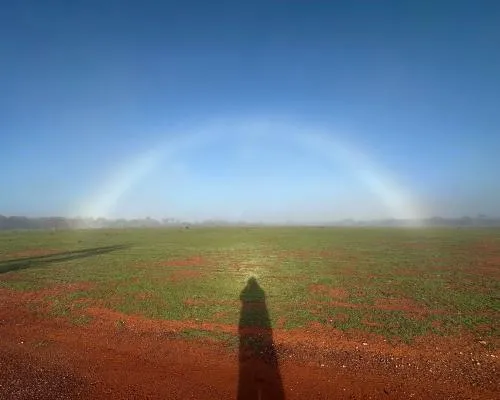
Fogbows are most commonly observed during autumn and winter in southeastern Australia, particularly where fog forms overnight. These conditions occur when the ground cools, causing moisture to condense into tiny water droplets near the Earth's surface.
Meteorologist Marie Johnson from Cobar in outback New South Wales experienced a fogbow first-hand. She recalls waking up one foggy morning and heading to town for work. 'I just thought I’d quickly call in, get a photo of the fog with the old house,' she says, but then turned around and saw an ethereal archway. 'Oh my God, look at that. It’s like a rainbow, but it’s white,' Johnson exclaimed.
Johnson's experience is not uncommon; fogbows are rare because specific conditions must align for them to form. According to Ilana Cherny, senior meteorologist at the Bureau of Meteorology, 'It really depends on you and the sun and the fog all being lined up in exactly the right way.' The water droplets need to be just the right size—typically between 10 and 150 microns—and the sun or moon must be positioned correctly behind the observer.
Other Optical Phenomena
Fogbows are part of a spectrum of atmospheric optical phenomena. For instance, cloudbows appear higher up in the sky and can be seen from an airplane with the sun behind you. Glories, diamond dust, and halos are other fascinating effects that occur due to light interacting with ice crystals or water droplets.
Cloudbows are similar to fogbows but appear at a higher altitude. To see one, the best viewpoint is from an airplane looking down with the sun behind you, says associate professor Martin Singh from Monash University. 'For a rainbow or a cloudbow, you need something for the light to reflect off. With a rainbow, it’s raindrops—falling rain. With a fogbow or a cloudbow, it’s either the tiny droplets of fog, which is cloud near the surface, or the tiny drops within clouds.' Glories are another striking illusion, appearing as smaller and more circular rainbow-like effects.
Observing Fogbows
Fogbows are quite rare in Australia. Dr Kimberley Reid, an atmospheric scientist at the University of Melbourne, emphasizes that while fogbows have significant societal impacts due to their influence on weather patterns such as flight delays and car accidents, they often go unnoticed by many people.
A notable incident occurred in December 2023 when more than 20 cars were involved in a multi-vehicle crash north-west of Melbourne. The thick fog blanketed the area, highlighting the dangerous conditions that can arise from such weather phenomena.
Rare and Localized Nature
Fogbows are difficult to observe because they occur so locally. Dr Reid explains, 'One of the challenges with fog is that you need people there to observe it. I’m sure we get lots more fogbows that only the kangaroos get to see.' However, when someone manages to capture one, as in Johnson's case, it’s a moment worth celebrating.
As Ilana Cherny stated, 'It’s great that we got one where someone was able to take a photo. These moments remind us of the beauty and complexity of nature’s optical illusions.'
Source: The Guardian

Green News
270 posts
-
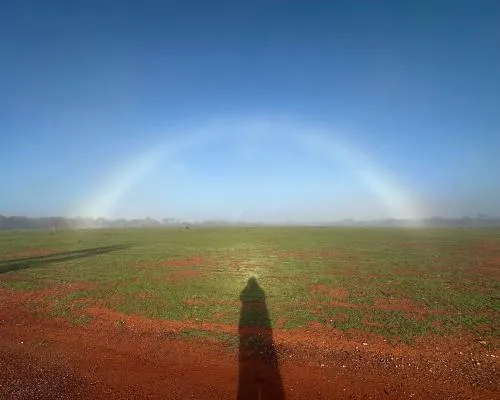 Mysterious Fogbows Emerge in Australia: A Rare Optical Illusion
Fogbows, rare atmospheric phenomena similar to rainbows but appearing in foggy conditions, have been observed in Australia. These fleeting illusions require precise alignment of sun and dense yet not too thick fog for visibility.
-
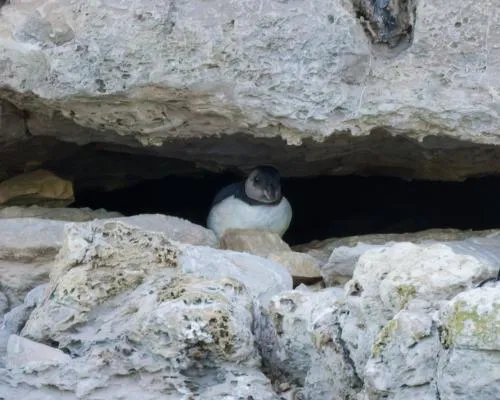 Rare Puffling Sighted After Three Decades on Dorset Coast
A rare puffling has been spotted on Dorset's coast after three decades, renewing hopes for the local puffin population.
-
 Water Leaks Outstrip Hosepipe Ban Savings in England and Wales
A new study reveals that water companies in England and Wales are losing five times more water through leaks than they could save with a hosepipe ban. Environmental campaigners warn of increasing droughts due to climate change.
-
 U.S. Voters Link Extreme Weather to Climate Crisis, Despite Trump’s Denials
A new survey reveals that the majority of American voters link extreme weather events, including heatwaves and floods, to the climate crisis. Despite Republican skepticism, the findings indicate growing public concern that surpasses political polarization on this issue.
-
 Carbon Capture as a Shield for Fossil Fuel Expansion Contested
An analysis of the arguments against using carbon capture as a shield for fossil fuel expansion, highlighting methane emissions and the superiority of renewable energy sources.
-
 UK Poultry Expansion Plan Met with Environmental and Food Security Concerns
Campaigners argue that the UK's proposed poultry growth plan could undermine national security due to its resource-intensive nature and reliance on imported feed.
-
 Critics Argue Carbon Capture Is a Deceptive Tool for Fossil Fuel Expansion
A letter in The Guardian discusses the high costs and limited effectiveness of carbon capture technologies compared to renewable energy sources, while critics argue these measures may merely serve as a cover for expanding fossil fuel industries.
-
 Topless Trends: The Scottish Custom of Taps Aff
Letters from readers discuss traditional Scottish practices like 'taps aff' and related debates on attire, prison conditions, and educational methods.
-
 Rare Sight: Red-Necked Phalarope Returns to Irish Marsh
A rare sighting of the red-necked phalarope, last seen breeding in Annagh Marsh for over 30 years, adds wonder and significance to a magical Irish coastal habitat.
-
 Innovative Energy Storage Solutions Revolutionize Clean Power
New battery technologies like cryobatteries, molten salt storage, sand batteries, and sweat-powered wearables are transforming the way we store and use renewable energy.


