- Brain implant helps paralyzed man move arms and hands.
- Technology sends signals back to the brain, recreating the sensation of touch.
- Improvements in hand function and sensations remain even when the system is off.
Revolutionary Treatment for Paralysis
A 48-year-old man named Keith Thomas from Massapequa, New York, has made remarkable progress thanks to a pioneering brain implant. Six years after suffering a spinal cord injury in a swimming accident, Thomas was unable to move his arms and hands. However, he successfully participated in a clinical trial using an innovative double neural bypass system developed by researchers at the Feinstein Institutes for Medical Research.
A Journey of Restoration
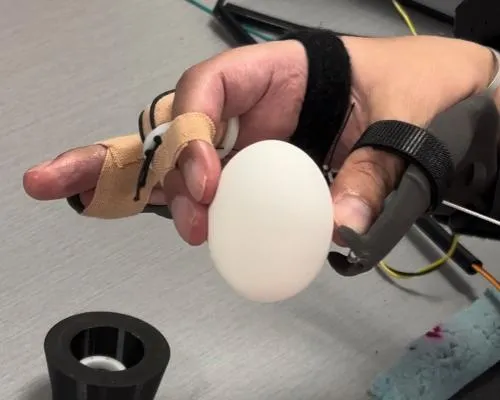
The implant, which includes electrodes placed directly into Thomas's brain, allows him to control his arm movements through signals that bypass his damaged spinal cord. Simultaneously, sensors on his hand provide tactile feedback, mimicking the sense of touch. In a 35-week training period, Thomas showed significant improvement: his right arm strength increased by 86%, and his left arm strength improved by 62%. He was able to perform tasks that were previously impossible, such as scratching his nose and wiping his face.
Restoration of Sensory Function
The researchers further enhanced Thomas's experience with a technique called cortical mirroring. This involved recording brain activity while he imagined being touched, followed by stimulating the same sensory regions in his brain. Simultaneously, they stimulated specific areas of his skin and spinal cord. After 25 weeks of therapy targeting his right wrist, Thomas regained sensation in an area that had been numb since his injury.
Long-Term Implications
Bouton, the lead researcher, expressed optimism about the long-term benefits of this technology. “These gains were still present after more than two years,” he said. While it is unclear how much function and sensation can be restored to paralyzed limbs in general, further trials involving multiple patients are needed to assess the effectiveness for different types of spinal cord injuries.
This breakthrough not only provides hope to those living with paralysis but also opens new avenues for neurorehabilitation research. The success story of Keith Thomas highlights the potential of brain-computer interfaces in restoring lost functions and enhancing quality of life for individuals with neurological disabilities.
Source: The Guardian

Science Daily
113 posts
-
 New Insights Suggest Mars Once Had Extensive Subsurface Magma
New research reveals Mars once had extensive subsurface magma reservoirs, challenging previous assumptions and expanding the potential habitability of similar planets.
-
 Mars Had Extensive Magma Rivers Under Its Surface, Research Suggests
Mars once had extensive magma rivers beneath its surface, expanding our understanding of its potential habitability.
-
 Solving the Coin Flip Puzzle: A Strategy That Boosts Your Chances
A game show scenario improves participants' chances from 25% to 50% by sharing one simple strategy.
-
 Puzzle Solution Reveals Surprising Strategy
A game show presents a coin-flipping challenge with an unusual winning strategy that increases the chances of success from 25% to 50%. The puzzle highlights simple probability rules and strategic thinking.
-
 Mystery Mushroom in China Prompts Hallucinations of Tiny People
A rare bolete mushroom from China can induce hallucinations of tiny people lasting for days. Researchers are studying its unique properties.
-
 Gene Editing Debate Excludes Deaf Community
A letter from Tom Lichy of the British Deaf Association highlights the exclusion of deaf people from gene-editing debates, advocating for more inclusive policy making.
-
 David Armstrong: Shaping Organisational Psychology Through Systems Psychodynamics
David Armstrong, a psychologist who spent over six decades shaping systems psychodynamics, passed away at 91. His work emphasized workplace democracy as key to innovation and efficiency.
-
 David Armstrong: A Pioneering Psychologist Who Transformed Organisational Thinking
Pioneering psychologist David Armstrong spent six decades researching systems psychodynamics, developing a practical language for understanding unconscious dimensions of work.
-
 UK Vet Industry Reforms May Include Prescription Caps, Licensing
The UK government is considering reforms to the veterinary sector, including prescription caps and mandatory licensing, aiming to address rising costs for pet owners.
-
 First Confirmed Atmosphere Around Rocky Exoplanet in Habitable Zone Discovered
Scientists have confirmed an atmosphere around LHS 1140b, a rocky exoplanet in the habitable zone outside our solar system.


