Bees Show 'Liking' and 'Disliking' Reactions: New Study Suggests Inner Lives for Insects

- Bumblebees display behaviors that suggest they can experience 'liking' or 'disliking' certain tastes.
- Scientists found bees showed more prolonged mouthpart activity after tasting sweet solutions, indicating a positive response.
- The study highlights the complexity of insect behavior and challenges traditional views on sentience in insects.
- Researchers emphasize the importance of context when interpreting bee responses to different tastes.
Understanding Bee Behavior: 'Liking' or 'Disliking'
In a groundbreaking study, researchers from Macquarie University and Southern Medical University in China have captured bumblebee behavior that suggests these insects can experience feelings similar to those observed in mammals. When bees taste sweet solutions, they keep their glossa (or insect tongues) out longer, almost as if they are tasting with pleasure. Conversely, when presented with salty or bitter substances like quinine, the bees show clear signs of aversion by shaking their heads and wiping their mouths.
Methodology and Findings
The study, published in the journal Proceedings of the National Academy of Sciences, involved presenting bumblebees with droplets of different solutions: 60% sugar, 20% sugar, plain water, 5% salt, or quinine (at a concentration of 1 millimolar). Scientists used slow-motion video to document the bees' reactions. Prof Andrew Barron from Macquarie University explains that these behaviors are consistent with what mammals display when they like or dislike something. He states, “Facial expressions are an important window into the internal states of animals.”
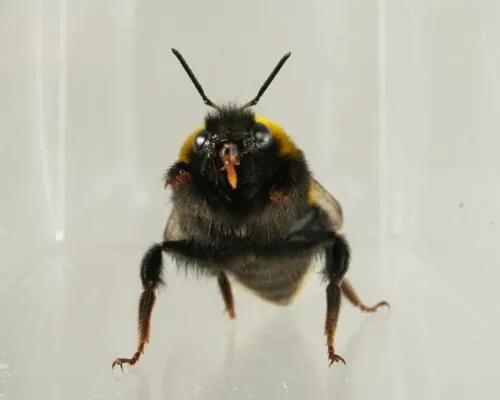
When bumblebees taste something good, they reach out their glossa – or insect tongue – for a while afterwards, almost as if they are licking their lips. And when they don’t like something, the insects will shake their heads and wipe their mouths. The researchers observed that bees displayed “post-consumption glossa” after tasting sweet solutions, continuing to lick even after finishing drinking. In contrast, they showed clear distaste for salt or quinine solutions.
Contextual Reactions and Controversies
To ensure their findings were not merely a chemical reflex, the scientists tested responses with 18 colonies under a range of circumstances, including when the bees were heat-stressed, already full, or given doses of different drugs. The bees’ reactions depended on context. For example, heat exposure changed their response to water or salty solutions from neutral or averse reactions to positive. As Prof Barron explains, “It is as if someone had offered you an electrolyte drink. You’d probably go ‘blegh’ most of the time. Unless you’ve just been out on a really, really hot day, and done an enormous run, in which case an electrolyte drink is exactly what your body needs and it tastes fantastic.”
Associate Prof Thomas White from the University of Sydney, who was not involved in the study, commented on the significance of this research. He said, “Research into insect behaviour and sentience is a fast-moving field. What made this study fascinating was its focus on the ‘positive side of life,’ as the vast majority of research investigates negative feelings, such as pain or fear.”
White noted that the picture is increasingly pushing towards a view that insects, or many insects, have some simple capacity to feel the world, not just to assess it and detect it but to actually have a point of view. This challenges people’s intuition about where we might draw the line in the animal kingdom as to what can feel pleasure and pain, hence the kind of ethical and moral responsibilities we have towards those animals.
Prof Barron emphasized, “There’s always been a tension between thinking of insects as animals or some sort of mini robots. This is another step towards showing there's an inner life to being a bee.” The study challenges the traditional view of insects as merely robots and suggests they have some capacity for subjective experience.
Source: The Guardian
Green News
222 posts
-
 Bees Show ‘Liking’ and ‘Disliking’ Reactions According to New Study
A new study reveals bumblebees displaying facial expressions similar to 'liking' or 'disliking' responses observed in mammals.
-
 Historic Geoengineering Ventures: From Giant Dams to Artificial Mountains
Tim Flannery outlines five outlandish geoengineering projects from history, including the Atlantropa dam, Soviet ice-melting plans, and Project Znamya's artificial sunlight mission.
-
 Historic Projects Aimed at Altering the Climate: From Bombing Ice Caps to Building Artificial Mountains
Tim Flannery recounts five ambitious historical plans aimed at altering Earth’s climate through grand engineering projects, highlighting humanity's enduring quest to control its environment.
-
 Europe’s Air Conditioning Debate Escalates Amid Record Heat
Europe faces a new culture war over air conditioning use amid record-breaking heatwaves, with political parties using it as an issue to gain support while health experts advocate for balanced solutions.
-
 Norfolk Swallowtail Butterfly Is Found To Be a Distinct Subspecies for Over 200,000 Years
A study reveals that Britain’s endangered Norfolk swallowtail butterfly has been a distinct subspecies for at least 200,000 years, challenging previous theories and highlighting the need for urgent conservation efforts.
-
 Reflections on the 1976 UK Heatwave: Lessons from History
Residents recall the 1976 UK heatwave, sharing stories of water scarcity, high temperatures, and adapting to extreme conditions.
-
 National Park Crisis Looms as Visitation Soars
The ancient groves of giant sequoias in Yosemite National Park provide a tranquil setting. However, the increasing number of visitors has put significant…
-
 Merlin Bird ID App to Integrate with Global Biodiversity Project
The Merlin bird identification app is now linked with eBird database, allowing real-time bird data collection for conservation efforts.
-
 Europe Bakes as Record Heatwaves Grip Multiple Countries
Europe and parts of China experience record-breaking heatwaves as June temperatures soar across multiple countries.
-
 A blackbird with a taste for musicals
Letter: Jane Horne wonders if other readers hear well-known tunes in blackbird song


