- The ancient Upton Lovell Shaman, previously assumed to be male, was identified as a woman through DNA analysis.
- A wealth of artifacts found in the grave suggest she held significant social and possibly spiritual status during the Bronze Age.
- This discovery challenges traditional assumptions about gender roles and leadership in prehistoric societies.
Revelation Shatters Previous Assumptions
The Upton Lovell Shaman, a 4,000-year-old individual who was long believed to be male based on physical appearance and associated artifacts, has been revealed as female through advanced DNA analysis. This groundbreaking revelation challenges previous narratives about gender roles in the Bronze Age.
Significant Bronze Age Burial Unveiled
The Upton Lovell Shaman's grave, first discovered in 1801 in Wiltshire, has been reinterpreted as a remarkable example of prehistoric society. The skeleton was accompanied by an extensive collection of tools and ceremonial items, including stone axes, metalworking tools, and the remains of a luxurious cloak made from animal bones. These artifacts suggest the individual held a position of significant importance.
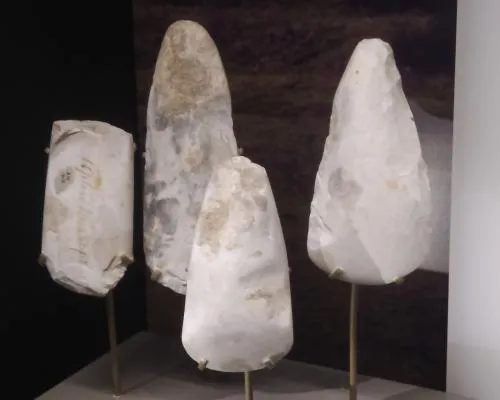
David Dawson, director of the Wiltshire Museum, commented on the findings: 'It completely tears up previous assumptions.' The artefacts imply that the shaman played a crucial role in both metalworking and possibly spiritual leadership, roles often associated with men during this period. Dawson added, 'We’re so used to the assumption of men do everything, men are the leaders, men are the metalworkers. Here we have smoking gun evidence of a female metalworker.'
Comprehensive Analysis of the Burial Site
The Upton Lovell burial site included several intriguing artifacts, such as a pouch decorated with boar's tusks and fossil sponges hollowed out into cups. The presence of these items, along with evidence of gold traces on stones, indicated that the shaman was involved in crafting ornaments, possibly including clasps made from bone or wood covered in thin sheets of gold.
The grave also contained what is believed to be a battle axe, crafted from greenstone brought from Cornwall. Dawson noted, 'Whether that was for fighting or for stunning an animal before it becomes your hog roast, we can’t be sure.' A secondary grave, initially assumed to contain the shaman's wife, was lost over time.
Significance and Broader Implications
The findings from Upton Lovell are part of a broader movement in archaeology where ancient DNA is providing new insights into prehistoric societies. The analysis of the Upton Lovell shaman's remains, performed by scientists at the Francis Crick Institute, revealed that she had Beaker ancestry, typical of Britain during her time.
Pontus Skoglund, senior group leader of the ancient genomics laboratory at the Crick, said: 'The field of ancient DNA has surged in technical capability over the last two decades, now giving us answers to questions that were previously inaccessible. It feels really good to give this to archaeologists.'
These discoveries have profound implications for our understanding of gender roles and leadership in prehistoric societies. Prof Mary Beard, a classicist and broadcaster involved in an upcoming exhibition on ancient DNA, highlighted the importance of these findings: 'As with the Upton Lovell shaman, DNA analysis can help us correct those assumptions and think harder about the roles of men and women in the deep past – and perhaps also about in our own world too.'
Source: The Guardian

Science Daily
113 posts
-
 New Insights Suggest Mars Once Had Extensive Subsurface Magma
New research reveals Mars once had extensive subsurface magma reservoirs, challenging previous assumptions and expanding the potential habitability of similar planets.
-
 Mars Had Extensive Magma Rivers Under Its Surface, Research Suggests
Mars once had extensive magma rivers beneath its surface, expanding our understanding of its potential habitability.
-
 Solving the Coin Flip Puzzle: A Strategy That Boosts Your Chances
A game show scenario improves participants' chances from 25% to 50% by sharing one simple strategy.
-
 Puzzle Solution Reveals Surprising Strategy
A game show presents a coin-flipping challenge with an unusual winning strategy that increases the chances of success from 25% to 50%. The puzzle highlights simple probability rules and strategic thinking.
-
 Mystery Mushroom in China Prompts Hallucinations of Tiny People
A rare bolete mushroom from China can induce hallucinations of tiny people lasting for days. Researchers are studying its unique properties.
-
 Gene Editing Debate Excludes Deaf Community
A letter from Tom Lichy of the British Deaf Association highlights the exclusion of deaf people from gene-editing debates, advocating for more inclusive policy making.
-
 David Armstrong: Shaping Organisational Psychology Through Systems Psychodynamics
David Armstrong, a psychologist who spent over six decades shaping systems psychodynamics, passed away at 91. His work emphasized workplace democracy as key to innovation and efficiency.
-
 David Armstrong: A Pioneering Psychologist Who Transformed Organisational Thinking
Pioneering psychologist David Armstrong spent six decades researching systems psychodynamics, developing a practical language for understanding unconscious dimensions of work.
-
 Innovative Brain Implant Restores Functionality in Paralyzed Man
A paralyzed man regains movement and touch sensation through a brain implant that bypasses his spinal cord injury, opening new possibilities for neurorehabilitation.
-
 UK Vet Industry Reforms May Include Prescription Caps, Licensing
The UK government is considering reforms to the veterinary sector, including prescription caps and mandatory licensing, aiming to address rising costs for pet owners.
-
 First Confirmed Atmosphere Around Rocky Exoplanet in Habitable Zone Discovered
Scientists have confirmed an atmosphere around LHS 1140b, a rocky exoplanet in the habitable zone outside our solar system.


