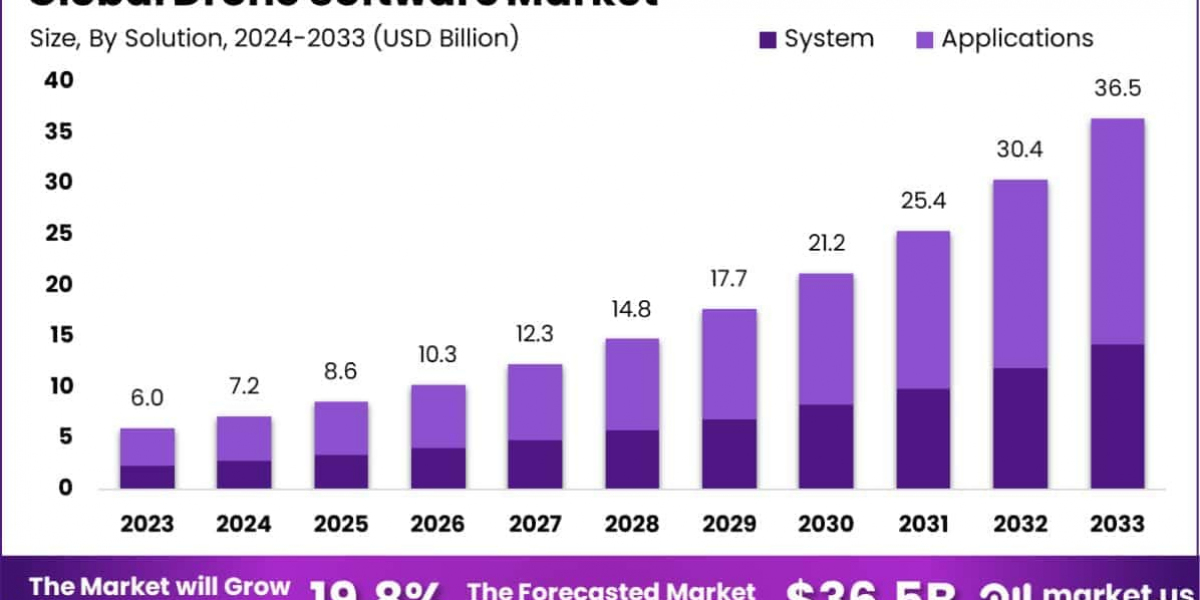
The Global Drone Software Market is projected to witness significant growth, reaching approximately USD 21.93 billion by 2033, up from USD 5.35 billion in 2023, growing at a CAGR of 15.2% during the forecast period. This growth is fueled by rising demand for UAVs across commercial, military, and civil sectors.
Increased applications in agriculture, logistics, mapping, and surveillance are driving software innovation. Enhanced data analytics, AI integration, and automation are key contributors to rising demand. Real-time data processing, mission planning, and remote control features have become vital, shaping the future of drone operations and expanding the scope of software solutions.
Key Takeaways
Market Size (2023): USD 5.35 Billion
Forecast (2033): USD 21.93 Billion
CAGR (2024–2033): 15.2%
Key drivers: automation, AI, real-time analytics

The Future of Flight: Drone Software Market Major application areas: defense, agriculture, logistics, surveillance
Dominant Market Position
North America currently holds the leading position in the drone software market due to its advanced defense infrastructure, heavy investment in commercial drone technology, and a strong presence of tech companies. The region's early adoption of drone applications in sectors like precision agriculture, infrastructure inspection, and delivery services has bolstered market leadership.
Regulatory support and innovation ecosystems further fuel growth. Europe and Asia-Pacific are emerging with increased investments, particularly in logistics and smart farming, but the U.S. continues to dominate in terms of revenue and technological innovation, driven by military demand and commercial-scale deployments.
Technology Perspective
The evolution of drone software has been marked by advancements in AI, computer vision, edge computing, and cloud-based analytics. Flight control systems, mission planning tools, and real-time data streaming platforms are increasingly powered by machine learning algorithms.
Software now enables features like autonomous navigation, obstacle detection, and multi-drone coordination. Open-source platforms have accelerated innovation and customization, while security protocols are being enhanced to protect against cyber threats. Integration with IoT and GIS platforms is enabling high-precision data gathering and interpretation across verticals. These innovations are making drone software more versatile, scalable, and indispensable across industries.
Dynamic Landscape
The drone software market is highly dynamic, driven by rapid tech upgrades, regulatory evolution, and shifting commercial demand. Startups and established tech players are competing through feature-rich, scalable platforms. Strategic collaborations, R&D investments, and acquisitions are reshaping the landscape, while policy frameworks and airspace regulations remain critical influencers.
Driver, Restraint, Opportunity, Challenges
Driver: Rising demand for autonomous drone operations across industries
Restraint: Regulatory constraints and data security concerns
Opportunity: Expansion in delivery, smart agriculture, and surveillance applications
Challenge: High integration complexity and lack of standardization across platforms
Use Cases
Crop health monitoring in precision agriculture
Infrastructure inspection (bridges, power lines)
Military reconnaissance and target tracking
Drone-based delivery in logistics
Disaster response and search operations
Aerial mapping and land surveying
Key Players Analysis
Leading vendors in the drone software market focus on innovation, user experience, and scalability. They offer robust solutions for both consumer and enterprise-level drones. Competitive strategies include AI-driven automation, cloud-based analytics, and customizable mission planning features. Companies are emphasizing modular software architecture for easy integration and updates.
Partnerships with hardware manufacturers enhance compatibility, while strong R&D pipelines enable rapid feature deployment. Market players are also targeting emerging sectors like urban air mobility and drone taxis. Regulatory adaptability, cybersecurity enhancements, and expanding application coverage continue to define the strategies of dominant players striving to retain and grow their global market share.
Recent Developments
Launch of AI-powered drone mission planning tools
Integration of 5G connectivity for real-time data transfer
Cloud-based fleet management solutions
Partnerships with agriculture and defense sectors
Development of edge computing-enabled drone software
Conclusion
The drone software market is on a steep growth trajectory, driven by innovations in AI, automation, and analytics. With expanding use cases across defense, agriculture, logistics, and inspection, the market promises robust opportunities. Regulatory advancements and technological standardization will be key to unlocking its full global potential in the coming decade.
Mike Boss
25 posts
-

Công nghệ chip trong bóng Trionda phát hiện va chạm đến mức nàoChi tiết về công nghệ bóng Trionda trong World Cup 2026, cách hệ thống cảm biến quán tính IMU phát hiện va chạm chính xác hơn 100 lần mỗi giây.
-

NASA triển khai robot cứu kính viễn vọngSwift trị giá 250 triệu USDNASA triển khai robot để cứu kính viễn vọngSwift trị giá 250 triệu USD, đặt ra phương án tương lai cho hoạt động tương tự.
-

Elon Musk's Social Media Focus on UK Race and Immigration Overshadows SpaceX IPOAn analysis of Elon Musk’s X posts reveals that he focused more on UK race and immigration during SpaceX’s IPO run-up than his own company.
-

Mark Zuckerberg: CEO công nghệ với đam mê chăn nuôi 'thịt bò tốt nhất thế giới'CEO Meta Mark Zuckerberg đầu tư vào dự án chăn nuôi để tạo ra loại thịt bò chất lượng cao nhất thế giới.
-

UK’s Stargate UK Datacentre Project: A Hyped but Hypothetical InvestmentThe Stargate UK datacentre project appears to be a largely hypothetical investment, with key partners failing to visit the proposed site. Local leaders question its feasibility and authenticity.
-

Cảm biến bóng xác định việt vị: Thế nào để quyết định chính xác?FIFA sử dụng cảm biến tích hợp trong quả bóng để xác định tình huống việt vị và đưa ra quyết định chính xác.
-
Blue Origin tái cấu hình phóng sau vụ nổ New GlennBlue Origin chuyển cấu hình phóng sau vụ nổ New Glenn để tăng tần suất bay.
-

OpenAI's Sydney Office: NSW Government's Hesitation Amid AI Dystopia FearsNSW government's cautious approach to OpenAI's Sydney office, balancing enthusiasm with environmental concerns.
-
Vạn Lý Trường Thành Xanh: Trồng Cây Nhanh hơn Rừng Tự NhiênDự án Vạn lý Trường thành Xanh trồng 66 tỷ cây xanh với tốc độ sinh trưởng nhanh hơn, hấp thụ CO2 hiệu quả hơn so với rừng tự nhiên.
-

AI tools heighten risk for children: Experts urge parents to take cautionAs AI tools become more sophisticated, children are at risk of having their photos used by predators to create explicit material. UK watchdogs advise parents to be cautious online.
-

Phương thức xác thực khuôn mặt khi đổi SIM sang điện thoại mớiBộ Khoa học và Công nghệ yêu cầu xác thực khuôn mặt khi đổi SIM sang máy mới để chống lại sử dụng SIM không chính chủ.


