- Scorpius, a famous zodiacal constellation, represents Orion’s mythical adversary.
- The full constellation is challenging to spot from UK due to its low position in the southern sky.
- Antares, the red-orange heart of the Scorpion, is a striking supergiant star nearing the end of its life.
- A moon will be visible near Antares on 24 July, enhancing the stargazing experience.
Introduction to Scorpius
This week we will take the opportunity to identify Scorpius, the Scorpion, one of the famous zodiacal constellations. In mythology, Scorpius is the creature sent to kill Orion, the hunter. The two constellations are therefore on opposite sides of the sky from one another, so that when Scorpius rises, Orion has already departed.
The full constellation is visible from more southerly latitudes, but for stargazers in the UK it can be one of the more frustrating to track down because it is so low that it never fully rises above the horizon. This makes Scorpius one of the more elusive constellations for British astronomers.
Key Stars and Observational Tips
The heart of the Scorpion is marked by Antares, a bright red supergiant star that gives off an intense, almost jewel-like glow. Its reddish hue has led to its name meaning “rival of Mars,” reflecting its striking appearance in the night sky.
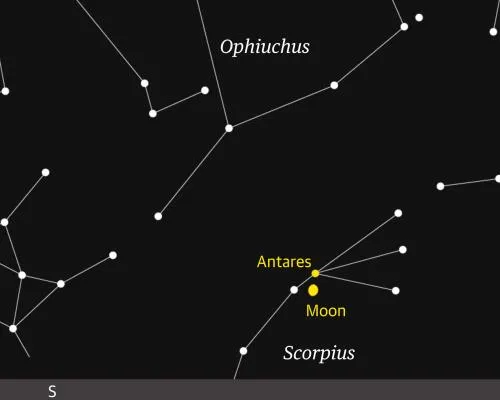
On 24 July, stargazers can use the waxing gibbous moon as a guide; the moon will be positioned near Antares, providing an excellent opportunity for observation. The chart shows the view looking low in the southern sky from London at 11pm BST on this date. The constellation remains in roughly the same part of the sky all week, but on this night the moon also graces the scene.
The bright waxing gibbous moon lies close to Antares, the red-orange star that marks the heart of the Scorpion. Its colour can be striking, appearing ruby jewel-like, although from Britain it often appears to twinkle because it is seen through the thicker, more turbulent air close to the horizon. Antares means “rival of Mars,” a reference to its reddish colour.
Antares serves as a significant celestial landmark, marking the end of the Scorpion’s body. Its immense size and nearing end of its life cycle make it a significant star in our night sky. Observers can spot Antares through even modest telescopes or binoculars, making it an engaging target for both amateur and experienced stargazers.
The constellation remains relatively static throughout the week, allowing observers to track Scorpius’s position with ease over multiple nights. This stability makes it a rewarding subject for any stargazer eager to witness the mythological tale of Orion and his nemesis, Scorpius, come alive in the night sky.
Conclusion
In summary, Scorpius presents both challenges and opportunities for UK-based astronomers. Despite its difficulty in observation due to its low altitude, this week offers a unique chance to spot Antares alongside the waxing gibbous moon. For those passionate about stargazing, it is an excellent opportunity to experience the rich mythology of the night sky while enjoying the visual beauty of one of our galaxy’s most fascinating stars.
Source: The Guardian

Science Daily
125 posts
-
 Gunther von Hagens, Creator of Body Worlds, Passes Away at 81
Gunther von Hagens, inventor of plastination and creator of Body Worlds exhibitions, has died at 81. His innovative technique and global displays sparked fascination and controversy alike.
-
 Restricted Eating Hours May Slow Cognitive Decline in Older Adults
A preliminary study suggests that restricting mealtimes and avoiding food before bed may help slow down cognitive decline in older adults.
-
 How Have Weight-Loss Drugs Affected Relationships?
The Guardian seeks to understand how GLP-1 drugs have affected relationships, both positively and negatively.
-
 The Need for Arts and Humanities in Space Exploration Debates
An exploration of why arts and humanities are vital for addressing the complex issues in current debates about space research.
-
 New Study Reveals Four Distinct Thinking Patterns Among Modern Minds
A new study identifies four distinct types of thinkers based on their thoughts, revealing how modern minds process information differently.
-
 GLP-1 Medications: Side Effects and Concerns
Explore the common and emerging side effects of GLP-1 medications, including digestive issues, hair thinning, and potential changes in facial appearance.
-
 Zendaya Wears Controversial Ancient Jewelry at Film Premiere, Sparking Debate
Zendaya’s decision to wear ancient Iranian jewelry at The Odyssey premiere has sparked debate about cultural sensitivity and ethical use of historical artifacts in Hollywood.
-
 Alan Turing's Racy Short Story Offers New Insight into the 'Playful' Side
A Cambridge academic has transcribed Alan Turing's previously overlooked short story, revealing new insights into the playful, funny, and sexually adventurous side of one of history's most influential figures.
-
 Tech Giants’ Space Datacenters Face Criticism Over Environmental Impact
Experts warn that proposed space datacenters from tech giants could release catastrophic levels of pollution and threaten the environment. A new petition demands a review by the FCC.
-
 Tech Giants' Space Data Centers Spark Concerns Over Environmental Impact
A petition has been submitted to the FCC urging a halt to space data center projects due to potential environmental hazards.


