- The waning crescent moon will pair up with the Pleiades star cluster on 11 July.
- Viewing is best from a clear, low horizon for optimal visibility at 3am BST.
- With binoculars, more stars in the Pleiades can be seen beyond just six naked-eye sightings.
Aligning Celestial Bodies
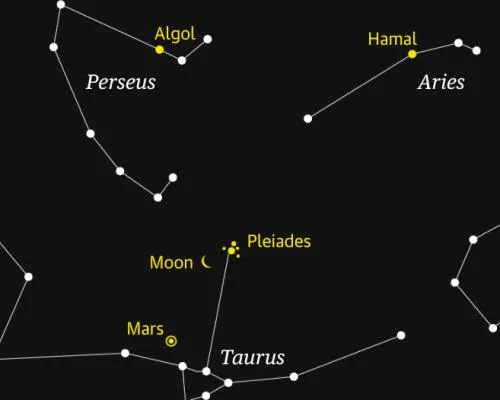
In the early hours of 11 July, the waning crescent moon will be gliding past the beautiful Pleiades star cluster, which is also known as M45 or the Seven Sisters. The chart shows the view looking east-north-east from a clear horizon at 3am BST. By then, the sky will getting ready to start brightening for the coming day, so a clear, low horizon will be essential to see the pairing.
The moon will be the easiest object to find: a thin crescent, just a few days old, with only 15% of its visible hemisphere illuminated. Its sunlit limb will be pointing down toward the horizon. The compact smudge of the Pleiades will be just off from the opposite, dark limb. With the naked eye, the cluster often looks like a mini version of the Plough. Despite its common name, most people see only six stars with the naked eye. However, if you have a pair of binoculars to hand, you will see many more stars.
Mars will also be nearby, though lower toward the horizon in Taurus, the Bull. It will be a difficult but rewarding spot if you can pick it out of the rapidly brightening sky. The view is also visible from the southern hemisphere, but Taurus rises in the north-east. This event is a beautiful reminder of the celestial dance that occurs every night across the sky, offering a spectacle that has fascinated humans for centuries. Whether you are an experienced astronomer or just starting to explore the night sky, this alignment provides an excellent opportunity to appreciate the beauty and complexity of our universe.
Source: The Guardian

Science Daily
81 posts
-
 Decades of Effort to Save Britain's Rare High Brown Fritillary Butterfly
Paul Dunn’s three-decade-long effort highlights the struggle to protect one of Britain’s most endangered butterflies.
-
 David Armstrong: Pioneering Psychologist Who Bridged Work and Psychoanalysis
David Armstrong spent six decades as a psychologist who transformed our understanding of unconscious dimensions in work. His pioneering contributions included influential books and continued teaching into his 90s.
-
 Massive Typhoon Bavi Heads Toward East Asia
Typhoon Bavi, expected to be one of the strongest in decades, is forecast to impact Taiwan and southeastern China.
-
 Government Considers New Vet Industry Reforms to Cut Costs and Increase Transparency
UK government proposes reforms including capping pet prescriptions and establishing a regulator to cut costs and increase transparency in the veterinary sector.
-
 Longest-lasting UK heatwave since 1976 persists
The UK is experiencing its longest heatwave since 1976 as part of this year’s third such event.
-
 Wegovy Weight-Loss Pill Launched in UK Pharmacies
The Wegovy weight-loss pill, similar to the injectable version of semaglutide, has been launched in UK pharmacies. It offers an alternative for those seeking daily oral medication.
-
 Understanding Flying Ant Day
Entomologist Sophia Herod explains that Flying Ant Day isn't one specific day but occurs multiple times during the summer.
-
 Weight-Loss Medication’s Impact on Spending: A Guardian Survey
The Guardian seeks personal stories from people whose spending habits on clothing and beauty products have changed after taking weight-loss medication.
-
 Puzzle Solution Reveals Surprising Strategy
Two contestants can increase their chances of winning a game by announcing their own coin flip result, raising the probability to 50%.
-
 TV Game Show Puzzle: Boost Your Chances with a Clever Strategy
Explore the probability behind a game show puzzle that offers contestants a better than 50% chance of winning by using a clever pre-game strategy.


