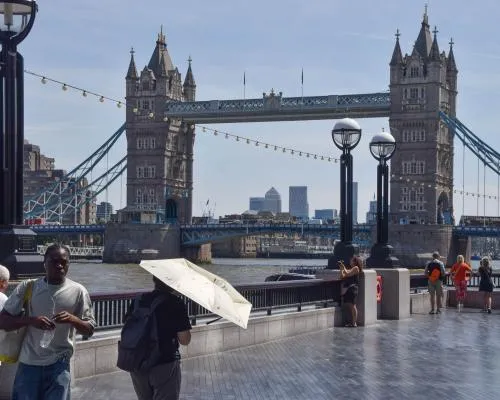
- Health alerts issued for England as temperatures hit 28C in London on Saturday.
- The Met Office forecasts a prolonged spell of hot weather, peaking to 34C in the south-east on Thursday or Friday.
- Southern Water has banned hosepipe use in Hampshire and the Isle of Wight due to the heatwave.
- Experts warn that such events are becoming more frequent with climate change.
Forecasted Peak Temperatures
The Met Office has issued a warning for an upcoming week-long heatwave across parts of the United Kingdom, predicting peak temperatures as high as 34°C in the south-eastern regions. Meteorologist Becky Mitchell stated: “We have got a heatwave on the way across parts of southern England and Wales, temperatures are already quite high across the south-east today. We could get around 28-29°C in London this weekend.”
Health Concerns and Water Restrictions
A series of yellow heat health alerts has been issued by the UK Health Security Agency (UKHSA) covering a wide range of regions in England, particularly targeting vulnerable people. The Met Office forecast predicts that the southern areas will experience prolonged warm weather, with temperatures climbing throughout the week.
These warnings are effective from midday on July 4th until 8 pm on July 11th, and they cover a range of regions including the east, East Midlands, West Midlands, south-west, London, and the south-east. The agency emphasized that within this warning area, high temperatures were likely to have minor impacts on health and social care services, including an increased use of healthcare services by vulnerable people and a greater risk to life for the same group.
Additionally, Southern Water has enforced a ban on hosepipe use for non-essential activities starting from 12:01 AM on July 10th in Hampshire and the Isle of Wight. The ban stops customers using a hosepipe for non-essential activities such as watering gardens, including via a sprinkler system; filling paddling pools, hot tubs, swimming pools, ponds, or fountains; and washing cars, patios, or windows.
Comparative Context
This heatwave won't be as hot or humid as last month's event but will still bring prolonged warm weather. The Met Office pointed out that the June 2023 heatwave saw temperature records broken, with a provisional record set in Lingwood, Norfolk. This exceeds the previous June record for the UK by more than 2°C.
The UKHSA's new alert comes after a heatwave last week during which the Met Office issued rare red warnings for extreme heat in parts of the country and red heat health alerts were put in place. It was the first time since extreme heat warnings were established in 2021 that a red warning for extreme heat was issued for three consecutive days in the UK, challenging records dating back several decades.
Future Climate Projections
The frequency and intensity of such events are increasing globally due to climate change. Met Office projections suggest that hot spells will become more frequent, especially in southern parts of the UK. According to the Met Office, temperatures across all seasons are expected to rise, but summers may see the most pronounced effects.
Meteorologist Becky Mitchell added: “There’s a north-south split – northern areas will be cloudier with spells of rain at times, so there is a distinct difference in weather patterns. The peak of the heat appears to be Thursday or Friday.”
Meanwhile, Southern Water's ban on hosepipe use highlights the growing concern over water conservation due to prolonged warm periods. This move aligns with broader efforts to manage water resources more efficiently under changing climatic conditions.
Conclusion
The ongoing heatwave and its associated health warnings underscore the evolving climate challenges in the UK. As temperatures continue to rise, understanding and preparing for these events are critical not only for public health but also for ensuring sustainable resource management. The Met Office's projections and the UKHSA's alert system play a crucial role in helping citizens and local authorities anticipate and mitigate potential impacts of such extreme weather conditions.
Source: The Guardian

Uk News Feed
283 posts
-
 UK set for week-long heatwave with 34C forecast
The United Kingdom is bracing for a week-long heatwave with peak temperatures reaching 34C in the south-east by Thursday or Friday.
-
 Trump Lawyers Seek Delay in Payment to E Jean Carroll
Trump’s legal team seeks court permission to delay payment of a $5.8 million judgment to E Jean Carroll, who claims she was sexually abused by the former president.
-
 Lịch sử bất ngờ: Những đề xuất sửa đổi hiến pháp khác biệt ở Mỹ
Lịch sử sửa đổi hiến pháp Mỹ chứng kiến nhiều ý tưởng khác thường, từ việc thay đổi tên quốc gia đến bãi bỏ chức tổng thống.
-
 British Woman Arrested After Alleged Stabbing Death of Boyfriend in Thai Rental Home
A British woman was arrested for allegedly stabbing her boyfriend to death in a luxury rental home near Pattaya, Thailand.
-
 Council Crackdown Fuels Homelessness Concerns Among Van Dwellers in Cornwall
Cornwall faces a growing homelessness crisis as local authorities crack down on unlicensed van dwellers, impacting vulnerable individuals who rely on temporary accommodation.
-
 Council Crackdown Threatens Homeless Residents in Cornwall
Cornwall’s council crackdown on planning infringements is leading to potential evictions among van dwellers and horsebox residents who have been struggling with housing shortages and high costs.
-
 Cape Verde: Đảo quốc nhỏ trở thành hiện tượng tại World Cup 2026
Cape Verde gây bất ngờ tại World Cup 2026 khi đội bóng quốc đảo nhỏ đầu tiên tham dự giải này thể hiện ấn tượng.
-
 Trump's Independence Day Address Sparks Controversy with Anti-Communist Rhetoric
President Donald Trump launched Independence Day celebrations by delivering an anti-communist speech at Mount Rushmore, focusing on upcoming midterm elections.
-
 Khóa huấn luyện 'helo dunker': Cách lính Mỹ thoát hiểm trong tình huống nguy cấp
Khóa huấn luyện 'helo dunker' giúp lính thủy đánh bộ Mỹ học cách thoát khỏi trực thăng bị lật úp và chìm xuống nước, nâng cao khả năng sinh tồn trong tình huống khẩn cấp.
-
 Pope Leo Honors US Immigration History During Lampedusa Visit
Pope Leo uses his first major address in the U.S. to praise its history of welcoming immigrants, while visiting Lampedusa to highlight the plight of refugees.


